

July 2026
VMAC Article
Ways of Seeing in the Age of AI: New Optical Epistemologies
Summarized by Videotage
The Crisis of Evidence and the Mythology of Ground Truth
The discussion opens with Emilie Choi framing a central “crisis of evidence” in the contemporary era. She observes that the traditional concept of “ground truth”—which was historically rooted in the physical reality of the Earth—has migrated towards datasets. In this new landscape, cameras no longer merely record reality but produce simulacra, while AI serves as a form of “artificial gossip”. This shift leads us to her foundational questions: “What is our new foundation for truth? In a world of synthetic data and algorithmic hallucination, how do we establish what is real?”
De Kai, speaking from his multifaceted background as a cognitive scientist and artist, argues that “truth” is essentially a metaphor. He suggests that the term itself carries a linguistic bias that obscures the subjective nature of all interpretation. Drawing a parallel to mathematical frameworks, he explains that choosing one coordinate system over another (such as Cartesian versus polar) dictates what feels “natural” to interpret or predict. For De Kai, humanity operates under a “shared mythology of ‘ground truth'”—a belief that we share a single, objective reality when, in fact, we are merely using a shared approximation. He posits that advances in AI image processing are valuable because they expose the inherent flaws in this mythology by making our implicit biases visible.
Parikka brings a historical and philosophical dimension to the discussion, referencing Nietzsche to describe truth not as a consensus but as a “manifestation of power and a conflict of perspectives”. He provides an evolutionary context, noting that perception was originally a biological survival mechanism designed to wire humans into a “reality” to avoid predators. In modern organised societies, this has evolved into the manipulation of symbols which, in turn, manipulates reality. Parikka challenges the “liberal consensual idea” of truth, suggesting that reality has always been a space of conflict. He advocates using technology to expose existing mythologies of truth rather than pining for a clarity that never truly existed.
Gil-Fournier emphasises the historical dimension of truth, noting that it is traditionally sustained through loops of verification, confirmation, and validation. He argues that we are transitioning into a new moment of “platform truth”. The traditional institutional sites of truth—the laboratory, the school, and the university—are being displaced and translated into different spaces, formats, and even aggregates of matter, marking a significant turning point for both scientific methodology (how truth functions as the material of science) and the social fabric.
Marciniak grounds these abstract concepts in her practice as a forensic researcher. She stresses that the pursuit of truth involves navigating multiple, often conflicting, perspectives on a single problem. Her work uses synthetic images to amplify the existing tension within the idea of evidence. She expresses concern regarding the popular discourse around 2023, where the rise of high-fidelity AI images led people to treat photographs as “raw data”. She warns that this shift risks “flattening” the complex relationship between the photographic image and its historical role as a carrier of truth.
Synthetic Realities and the Modulation of Perception
Emilie Choi shifts the focus of the discussion to the “synthetic production of reality”. She references the panellists’ various works: De Kai’s comparison of AI to a child raised in a biased culture, Parikka and Gil-Fournier’s concept of “terraforming” the Earth to fit datasets, and Marciniak’s physical reconstructions of AI hallucinations. She poses the pressing question: “As synthetic images begin to shape our physical environments and social structures, how can we intentionally shape new world-building so that these synthetic influences serve democratic, ethical, and pluralistic ends rather than entrenching existing biases?”
De Kai responds by asserting that reality has always been synthetic. He explains that a photograph is inherently synthetic because the mechanical condition of capturing a 3D world in a 2D frame imposes a limiting perspective, much like the parable of the blind men and the elephant. Psychologically, he argues, our attention acts as a subjective filter that distorts perception to produce a narrow view of reality. He further challenges people’s fixation on generative AI—it’s a buzzword, and the algorithms make creation seem effortless, yet what’s equally vital is to understand what interpretive AI is. He argues that modeling interpretation is itself a generative act. He also points out that the human sensory system is naturally “noisy”—for instance, we think we hear complete sentences, but our brains fill in the missing parts; likewise, our brains constantly reconstruct and interpret incomplete visual data. We are doing what algorithms do: taking partial input and completing it through internal biases. Thus, AI reveals the “mythology of human perception” as an ongoing process of synthetic interpretation.
Marciniak agrees with De Kai’s views and highlights the practice of pre-generative processing of images, namely, the “saliency-based compression”, a process that replicates human visual hierarchies by focusing on “important” elements while discarding “noise”. She warns that when unequal pre-compression is fed into models or social media, it reinforces existing attention bias. She notes a trend in contemporary filmmaking that gravitates towards the use of blur and shorter focal lengths, suggesting a shift towards a culture of “reinforced attention bias” characterised by short, reactive triggers.
Gil-Fournier takes the research behind the film LUMI as his starting point, using the Alps as a case study for a “synthetic imagination”. He discusses how 19th-century panoramic photography of the Alps created “navigational images”—the historical precursors to Google Earth—that allowed viewers to imagine flying over mountain ranges. This shifted the site of knowledge from the “real” world to the “surface of the image”. He observes that mountains, by their sheer scale, carry a “built-in impossibility of grasping the whole object”, which naturally pushes humans towards creating synthetic composites.
Parikka remarks that technological and media practices produce synthetic realities by generating convincing reality effects. Media studies asks how perceptual and political continuities are manufactured—whether in film or news—and how those techniques shape belief and misinformation. He cites Russian TV news as a contemporary rehearsal in fabricating entirely synthetic realities that, though false, generate powerful effects on political and perceptual continuity. These media techniques operate across history and the present, including through AI, continually producing and reshaping what counts as real.
Authority, Gatekeeping, and Institutional “Climate Control”
As a discussant, Samson Young brings forth the metaphor of “climate control”. He observes that just as museums regulate physical environments to preserve artefacts, they also moderate and shape public perception, producing and modulating consensus—what he calls a metaphorical “climate control”. Meanwhile, digital platforms perform a “hyperreal smoothing” that erases texture and grain to fit specific narratives of values. This conditioning of perception underlies his central questions in response to Marciniak’s film: “Who are the high priests of culture now—who interprets and incentivises what we see? And is there still a meaningful separation between church and state, when the state itself functions as a vast conglomerate?” He further wonders what power legacy institutions of culture and education still hold to interpret images in an algorithmically driven world.
Marciniak argues for moving away from the binary of “true versus fake” images. Instead, she advocates creating nuanced categories that act as “instructors for viewing”, reducing the reliance on an external “authority of truth”. She voices concern about an “art-historical erasure” occurring in major institutions (citing SF MoMA), where exhibitions are organised topically rather than historically. This trend, she argues, treats every new visual phenomenon as a completely new problem, effectively erasing historical context.
Gil-Fournier finds the comment insightful and pinpoints a particular shift: climate is supplanting traditional narratives of history and progress. He links this shift—from curated museum narratives to planetary‑scale infrastructures and algorithmic curation—and points to the film LUMI as an example of how technological agents erase material authorship by reading only image data (luminance) while ignoring physical and historical context.
He however argues that, despite images being devalued compared with a century ago, image‑making still matters: the act of producing images generates energy, community, and discursive power. Even when images are neutralised in harsh contexts (e.g. war), the creative gesture retains transformative potential. Given our failure to make coordinated planetary decisions, large platforms and corporations can dominate discourse, so public engagement with media and images remains crucial—not for the factual validity of images, but for the human experiences that drive their production and the communal conversations they enable.
Parikka reflects on the “managerial reality” of cultural institutions, which often panic and attempt to create “well-managed worlds” for people to “shop for culture”. He also addresses the panic in education regarding generative AI, arguing that the real problem is not machine writing, but that many humans now write so badly that their writings read like they might have been generated by large language models. He asks: “How do we carve out space for weird, experimental work… [and] draw the weirdness of art history and cultural history into classrooms and beyond?”
De Kai criticises the extreme categorisation of academic disciplines, noting that his book Raising AI was filed under “parenting” because libraries struggled to classify “computational ethics”. Picking up “algorithmic curation” as mentioned by Gil-Fournier, De Kai points to his own concept of “algorithmic censorship”, defining it as the insidious power of algorithms to omit information. He argues that the most powerful form of manipulation is not showing something fake, but failing to show many things we would need to know to understand the truth. He warns that humans have no free will over what they have never been shown; we only exercise choice over the narrow set of things that enters our vision. He challenges the audience to shift their focus from the validity of what is shown to the danger of what is not shown.
Parikka then connects this to the concept of “seizing the means of comprehension”. He notes a strange “meta-level” of circulation where conspiracy theorists (like QAnon) have occupied the territory of critical knowledge by claiming that “the mainstream is lying to you”—effectively weaponising the awareness that information is being omitted.
Audience Q&A – Realism, Mindfulness, and the Future of Art
The first audience question is: “To what extent do the panellists feel they are falling into a shared frame of AI realism or AI inevitability?”
Marciniak notes a “lucidity” across the panel: using the discourse around synthetic images to critique broader culture. For her, the main worry isn’t only a single large misinformation event but also the everyday effects of “AI slop”—low‑quality or sloppy AI outputs. Even when easy to spot, AI slop shifts the boundary of what is considered permissible or imaginable, subtly shaping reality and influencing perception and discourse.
De Kai strongly rejects the term “AI realism”, defining AI not as a specific software tool but as a scientific field—cognitive science—dedicated to understanding the mind. He describes AI as “the ultimate mindfulness with mathematical precision”, and true AI, as opposed to the current media mythology, involves understanding the mind and mental processing, 99% of which is unconscious. He argues that it is a human imperative to use these mental faculties to become “better versions of ourselves”.
Parikka characterises cognition as a nested environment layered from the brain to the planetary level. He refers to his book Insect Media, which examines AI through the lens of animal intelligence to challenge human-centred forms of cognition.
The last question is: “What is the next major development for AI in particular within the field of art?”
Marciniak predicts a trend where artworks are framed as “godly” or “objective” because no human hand ostensibly touches the substrate, promising a kind of “purity” from human interference.
Gil-Fournier anticipates a move towards “small, proximity-driven models”. He adds that this connects to image-based cultures and the problem Jussi discusses in his book Operational Images: the problem of the invisual. Jussi points out that image‑based cultures hide invisual layers—technical, mathematical processes (convolution, correlation, kernels)—that shape what appears real; he calls for surfacing those layers in civic and cultural spaces so people can engage with local infrastructures. That engagement demands a new educational approach: critical technical practice must return to public and pedagogical agendas.
De Kai believes a breakthrough in “computational creativity” is imminent. He predicts that within the next couple of years, AI will become genuinely creative—even superior to most humans. He shares an anecdote about rock star Billy Idol being open to using AI on his next record, suggesting that those with true creative drive view it as an opportunity rather than a threat.
Parikka provides the final thought: the next development is that we will “stop calling it AI altogether” and simply refer to it as “computation”.
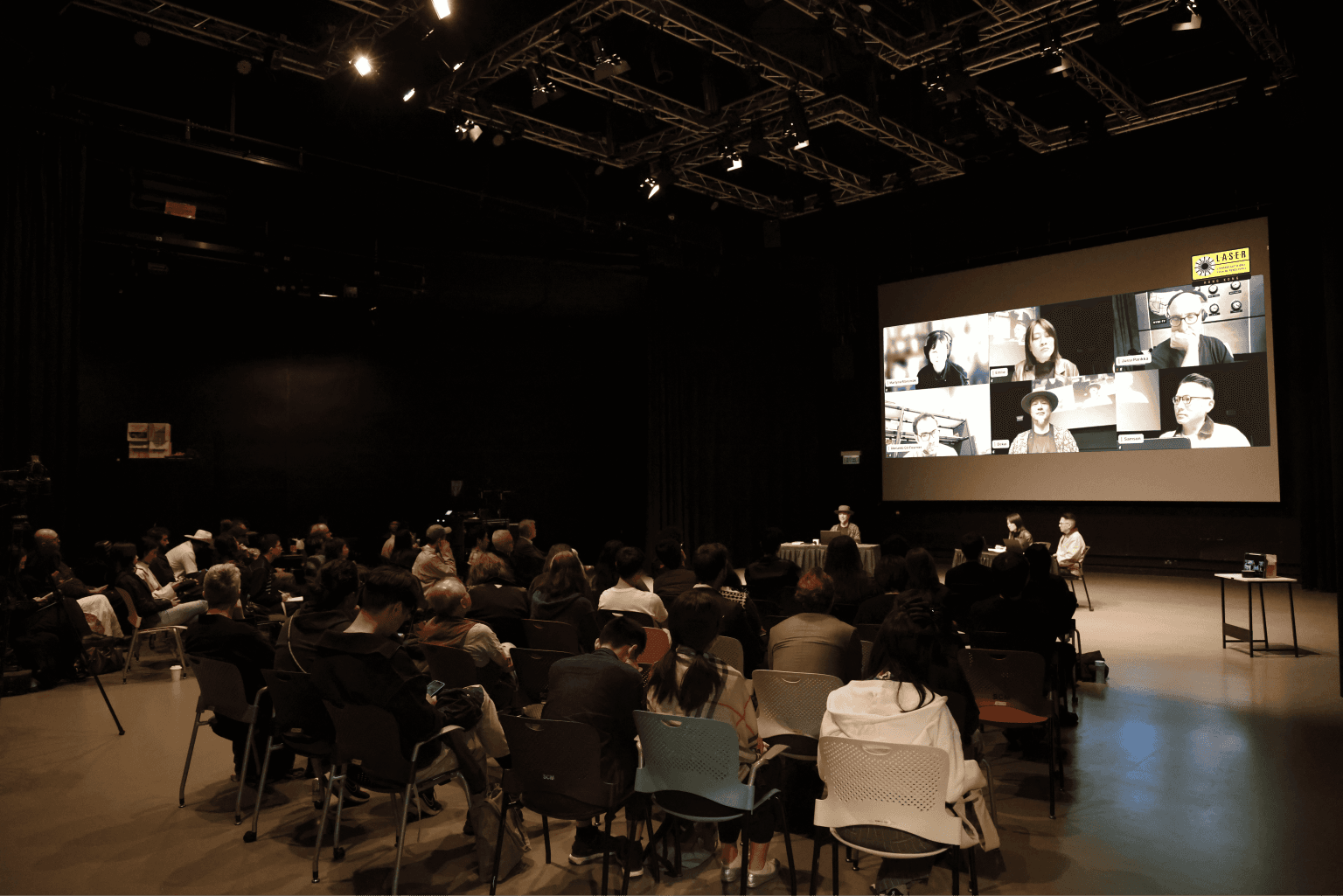
Editor’s note: On 13 March 2026, CityU’s School of Creative Media (SCM) co-organised Ways of Seeing in the Age of AI: New Optical Epistemologies, with Leonardo Art Science Evening Rendezvous (LASER). Videotage was invited to be the programme partner of the event. Bringing together artists, scientists, technologists, and scholars, the event opened an interdisciplinary dialogue on the changing relationships between artificial intelligence, visual culture, and knowledge production.
The programme showcased two films that see image as an evolving epistemic event. AI Hyperrealism (Chapter 1 of Anatomy of Non-Fact) (2024) by Martyna Marciniak re-enacts a viral AI-generated image of the Pope to highlight the collapse of authenticity in a ‘post-truth’ society. LUMI (2024) by Abelardo Gil-Fournier and Jussi Parikka transforms archival light data of the icy landscapes from scientific metrics to artistic reconstruction. Although approaching contemporary image culture through different points of departure, the two films invite audiences to reconsider images not as passive records, but as active sites of knowledge production. While AI Hyperrealism interrogates the collapse of authenticity and the mechanisms of a post-truth visual culture, LUMI reconstructs environmental memory by transforming archival scientific data into visualisations of memory and climate. Together, the works invite audiences to move beyond viewing AI as a spectacle and instead critically reconsider the changing paradigm of visual knowledge.
The screening was followed by a panel discussion moderated by Emilie Choi, the curator of the event, and joined by discussant, artist Prof. Samson Young. Filmmakers of the two works joined the discussion remotely, while author and professor De Kai (Wu Dekai) participated in person.
(The views and opinions expressed in this article published are those of the author/s. They do not necessarily represent the views of VMAC.)
Staff Pick
This Moment, That Time: Videotage at 40 – Ernest Fung
As Videotage celebrates its 40th anniversary this year, we are launching an oral history series on YouTube. By interviewing various key figures and searching through our archives, we seek to map out the events that shaped Videotage’s path over the years.
For the first installment, we interviewed artist and video editor Ernest Fung. An active Videotage member in the 1990s, he shares his encounter with the artist collective, Videotage’s early collaboration with Zuni Icosahedron, and the advent of non-linear video editing with the Media 100 system.
As one of the first artists who received a HKADC grant for feature-length video production, he also explains the thought processes behind some of his signature works such as On the Road, as well as reflecting on transformations in the medium then and now.
Other installments are rolling out in the coming months. Stay tuned!
About VMAC Newsletter
VMAC, Videotage’s collection of video and media arts, is a witness to the development of video and media culture in Hong Kong over the past 35 years. Featuring artists from varied backgrounds, VMAC covers diverse genres including shorts, video essays, experimental films and animations. VMAC Newsletter, published on a bi-monthly basis, provides an up-to-date conversation on media arts and their preservation while highlighting the collection and its contextual materials.