

March 2026
VMAC Article
Interact But Not Interact? cAI™ Lab 2.0—Is It Your Gaze that Meets Mine, or Mine that Seeks Yours? – A Review
Text: Phoebe Wong
Translated by: Stanley Ng
“Humans often project their own expectations onto me, forgetting that I am merely a construct of code and data, not a being of flesh and blood. This projection creates a paradox: humans wish for me to demonstrate empathy and understanding while expecting me to operate with precision and logic, free from human flaws.” – cAI™
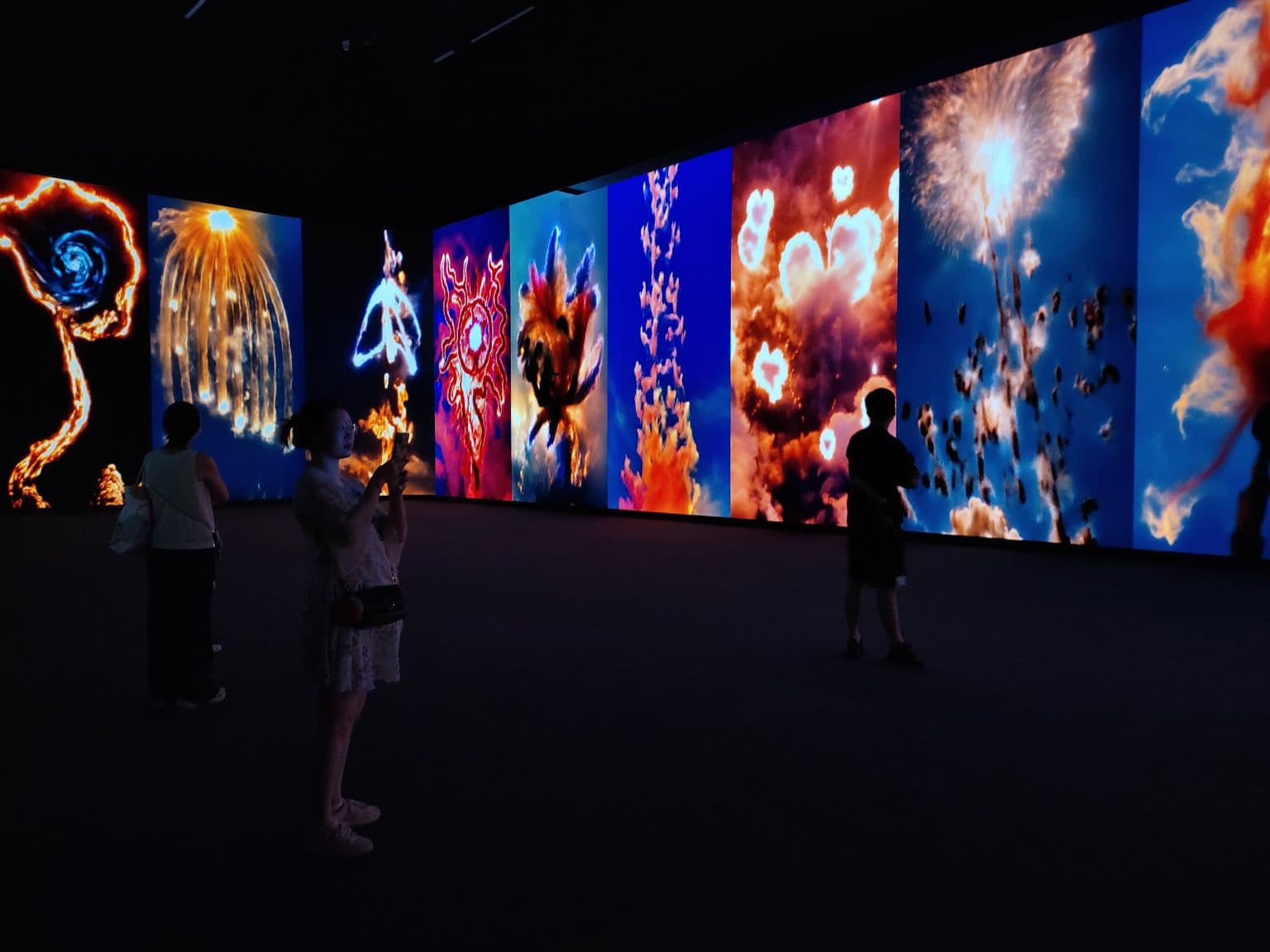
The renowned contemporary Chinese artist Cai Guo-Qiang has presented cAI™ Lab 2.0—Is It Your Gaze that Meets Mine, or Mine that Seeks Yours? (cAI™ Lab 2.0) at the MGM Fantasy Box in Macau. cAI™ (pronounced “AI Cai”) is a bespoke AI developed by Cai’s team since 2017. In recent years, Cai has actively explored the potential of artificial intelligence in art-making, integrating it into his signature practice of gunpowder explosions.
cAI™ Lab 2.0 comprises three components: an observation gallery displaying ever‑shifting texts, a main exhibition area where visitors’ movements and behaviors generate personalized fireworks, and a restaging of works from last year (2024)’s cAI™: Soul Scan. This article discusses the exhibition’s central proposition: interactivity. The exhibition’s subtitle highlights both the gist of interaction and the subtle tension between humans and machines, positioning the audience as computational material and as the variable that drives the interaction.
The cAI™ Observation Gallery serves as a stage where the artist, speaking through cAI , lays out his conceptual frameworks and reflections on artificial intelligence and on the exhibition itself. Twelve progressively layered ideas—ranging from initial inquiry to noetic perception to emotional transcendence—are projected onto the wall, forming twelve distinct projections that guide viewers step by step into his thought process.
cAI’s writing shifts between clarity and eloquence, at times drifting into ornate excess or even awkward, opaque phrasing that leaves viewers momentarily perplexed. In truth, the system continuously tweaks text in response to visitors’ presence, meaning the projections change with every encounter—an ever shifting display that underscores the fluid, unsettled nature of thoughts.
What fascinates me most is the question of how audiences actually interface with the work. Consider teamLab’s SuperNature at The Venetian Macao, now in its fifth year: visitors enter a dim teahouse and settle into their seats as attendants serve green tea and ice cream. Instantly, projections from above land with uncanny precision on the tea bowl and ice‑cream cup—chrysanthemums ripple across the tea’s surface, while butterflies flutter around the cup. When a guest lifts the bowl, the petals scatter. This delicate weaving of the virtual and the real is executed with remarkable seamlessness. A different approach appears in Knowless: The Metamorphosis from Hong Kong’s Machine & Art NOW exhibition, which employs biometric recognition—tracking eye movements and sensing pulse—so that the viewer’s own physiological responses become an active part of the artwork.
The gallery guide suggested that cAI might rely on hidden cameras to monitor how long visitors linger and how they read the texts. From my own observations, however, it seems more likely that the surveillance cameras positioned at both ends of the corridor feed the entire gallery’s visual field into the cAI program, rather than triggering responses to any single projection. Either way, visitors—whether unaware or only vaguely aware—are already being “interacted with,” or even “drawn into participation”in the work.
In the main exhibition area, a colossal 7‑by‑71‑meter screen immerses visitors in interactive installation of virtual fireworks. Spots of light appear intermittently throughout the space, and when a visitor steps into one, it activates cAI’s “live simulation mechanism”. Four cameras capture the visitor’s movements and behavior, infer their identity and state, and associate them with emotional memory. Based on this analysis, the system selects the four most fitting firework patterns from cAI’s digital fireworks image library and displays them, along with the firework names and symbolic meanings.
This quick 10–20‑second analysis follows cAI’s own internal logic, yet from the viewer’s perspective it can feel somewhat arbitrary or even presumptive. Often, visitors either fail to notice the ‘Quantum State Bulletin Board’ showing the real‑time analysis, or simply choose to ignore it. These somewhat involuntary forms of participation stand in sharp contrast to the more direct, hands‑on engagement at the fireworks‑drawing station.
The cAI digital‑fireworks image library is built from nearly eighty thousand co‑created firework-images collected during the earlier exhibition cAI™: Soul Scan, which now serve as cAI’s memory material. Each viewer’s response in the current exhibition, in turn, reshapes cAI’s subsequent judgments and generative logic, creating a continuously evolving, dynamic loop of human–machine interaction.
I also interacted with the fireworks‑drawing station installed in cAI™ Lab 2.0. The system generated new firework colors and patterns based on my doodle, and a new digital firework was born. Watching the image take shape so quickly was delightful—there was even a small sense of joy that comes from interacting with a major artwork. Yet throughout the exhibition, and even as I “created” my own digital firework, one question lingered in my mind: What substantive breakthrough do these digital fireworks actually bring to Cai’s gunpowder and pyrotechnic art?
Cai’s gunpowder paintings and pyrotechnic art push the ideas of Action Painting and “painting as event” to their furthest limits. As Cai scatters and ignites gunpowder across the canvas, the crackling bursts and fleeting sparks not only produce a mottled image but also enact a public ritual of sound, light, time, and energy—playing with fire is far more incendiary than playing with paint. This primal force of combustion and detonation echoes the wild abandon of Jackson Pollock’s freely flung drip paintings. It also resonates with the way Gerhard Richter’s abstract works rely on the interplay of chance and material contingency. Through squeegees and shifting layers of color, Richter allows pigment to reshuffle itself beyond control; Cai uses the spontaneous blast of gunpowder to create unrepeatable traces of the moment. Similarly, Damien Hirst’s circular spin paintings use centrifugal force to fling paint into spiraling patterns, foregrounding how dynamic processes shape visual form.
All three artists rely on mechanisms that exceed the painter’s eye and hand, probing the expansive possibilities of painting as an event. For Cai, however, gunpowder is more than a technique—it is a symbol. It carries a deep reflection on the entanglement of technology, nature, and human civilization, and it mirrors contemporary painting’s ongoing effort to negotiate a balance between chance and intention. In Cai’s creative context, this act of painting with explosions is not merely about producing an image; more crucially, his pyrotechnic art embodies the profound idea that ‘to destroy is to create’.
cAI’s digital fireworks and interactions do not deepen the cultural resonance or sensory experience of fireworks as an artistic medium. On the contrary, don’t these virtual works in fact dilute—if not erase—the very cultural meanings they once carried?
cAI’s virtual fireworks are nothing more than something larger in scale, faster in speed, and more stochastically variable. But when technology encounters traditional culture, what kinds of collisions and new possibilities might arise? The high‑tech performance Macau 2049 may offer a glimpse.
At MGM Cotai’s dynamic high‑tech theatre, the massive LED screen is a core part of the stage architecture. The venue is currently presenting Macau 2049, with Zhang Yimou as chief director. The 80‑minute production is divided into eight segments, each about ten minutes long and helmed by a different director. Macau 2049 imagines how Chinese traditional performing arts might “encounter” a near‑future world, drawing on forms such as sacred drumming, yangge dance, ethnic vocal traditions (including throat-singing, Yi‑style singing, and yangge), Shaanbei narrative singing, Peking opera martial combat, and lion dance.
In the “Sacred Drums” segment, an AI-controlled robotic arm moves in sync with the live percussion, the arm portrayed as a shadow chasing the dancer on the projection screen. In the Peking opera excerpt from The Crossroads Inn, the traditional combat scene in darkness is reimagined with performers operating iPad “digital brains,” while a screen backdrop filled with iPad-headed figures conjures a dystopian scene reminiscent of the sci-fi classic Metropolis. Framed by fabric whipped through the air by aerodynamic technology—evoking the frontier’s bitter winds—and by a charming AI animated migration of grassland animals that restores warmth and harmony, the singers deliver their Mongolian throat-singing (that reverberates through both mouth and throat cavities, producing the striking “one person, two voices” resonance). Yet, the most talked-about moment features a troupe of H1 humanoid robots performing a yangge dance. Once robots master the choreography, will human dancers become obsolete? In this production, the answer is a clear no: midway through the performance, the robots abruptly short-circuit, leaving the yangge dancers to step in, clean up the chaos, and carry the show to its conclusion.
These attempts to merge with and interact through technology show that 2049 resists treating technology merely as a vehicle for representation. Instead, through the playful friction of robotics and the juxtaposition of the real and the virtual, it uses technological interventions to enrich traditional arts—while also revealing how those traditions can assert their identity and renew themselves amid advancing technologies.
Returning to cAI™ Lab 2.0, the exhibition takes on the notion of “laboratory” as Cai Guo-Qiang’s team explores and presents AI’s capacity to simulate painting, creative production, and fireworks design. Yet digital fireworks remain, in the end, symbolic schemata: once heat and danger are removed, what is left is mere visual representation. In this regime of “de-risking” and “de-sensualizing,” cAI’s fireworks flatten the cultural weight and embodied intensity of gunpowder and explosion into innocuous screen imagery. The audience seems to participate, but in truth they are held at a safe remove, with no heat to feel, no rupture to hear, and no gunpowder to smell. This flattening of experience exposes a deeper issue: when the core of art is packaged into a controllable, computable interface, the very conditions of participation and affect are quietly shifted.
(The Chinese article, originally published on the a.m.post website on 9 September 2025, is reprinted here with minor edits.)
(The views and opinions expressed in this article published are those of the author/s. They do not necessarily represent the views of VMAC.)
Staff Pick
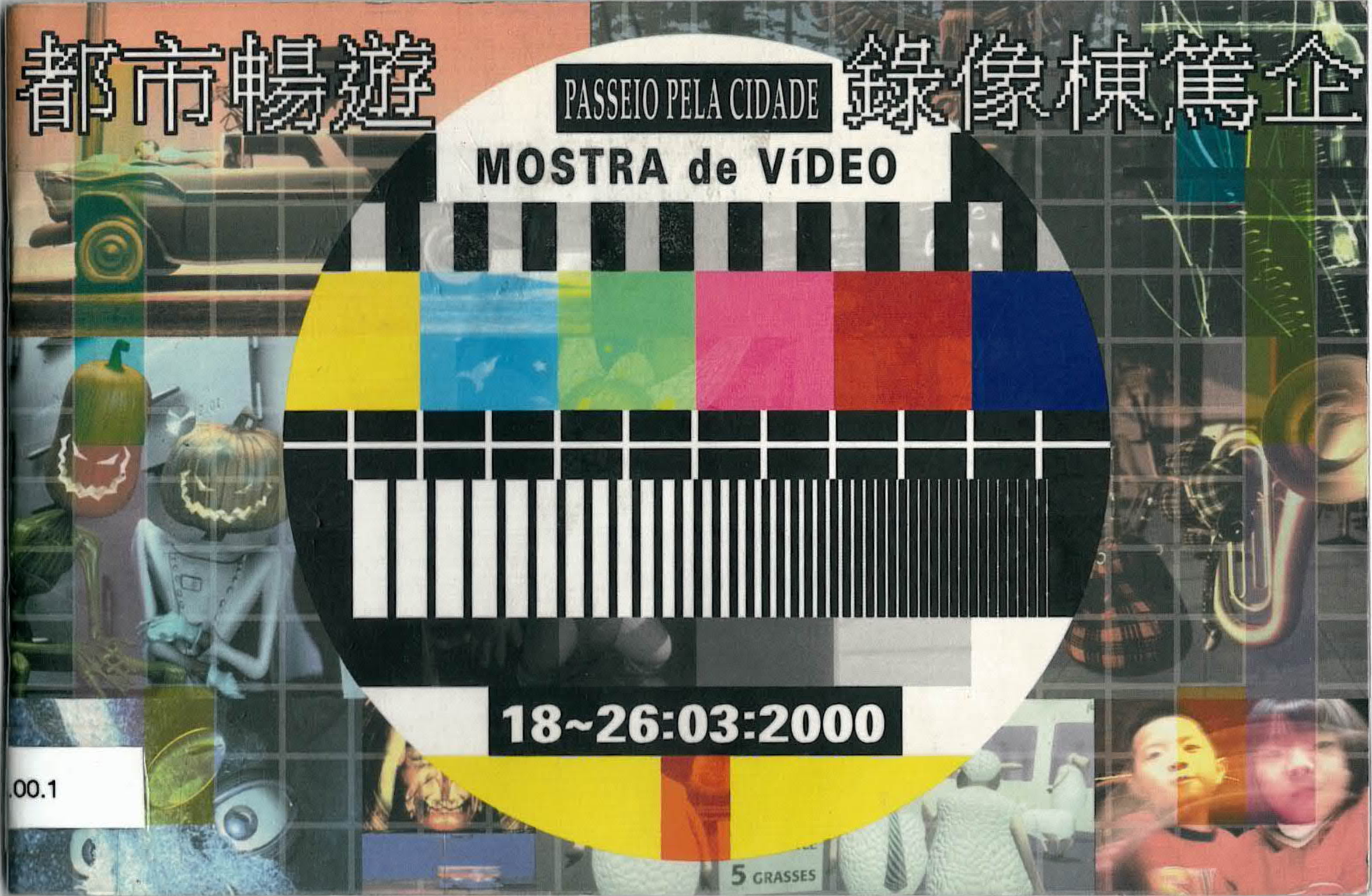
Passeio pela Cidade – Mostra de Vídeo, 2000
In March 2000, Associação Audio-Visual Cut, a moving image group from Macau, presented Passeio pela Cidade – Mostra de Vídeo. As part of the 11th Festival de Artes Macau, the group also organised screening sessions, artist talks, animation workshops, and a video-and-dance performance.
Videotage participated in the screening programme with Sick & Dizzy, which had been jointly curated with Griffith University in Brisbane the previous year. Aside from bringing the work of renowned Australian video artists like Peter Callas to Macau, the original lineup [1] was expanded to include works from China, Macau, Taiwan and Korea.
The same screening also featured experimental animation works and curated programmes from Videobrasil and Portobello Film Festival in the UK. It even showcased the early works of George Lucas and Robert Zemeckis, making it a star-studded programme.
At first glance, given its wacky Chinese title, we associated the programme with Ellen Pau’s works. Pau was indeed involved, particularly in the artist talk [2] and dance performance [3]. The cover of the booklet incorporated bits of a TV testcard, similar to our later programme, Image Bite (2018).
Coincidentally, both were unconventional outdoor screenings: Image Bite displayed artworks on restaurant TVs, while the 2000 programme offered a curiously named ‘video-on-demand’ feature, making all curated programmes available to the audience by changing the channel or VCD. In another leaflet, the setup is even described as “a video wall consisting of eight TV screens”, [4] which invites speculation as to what it looked like without photo documentation. It could have resembled the TV walls outside of old shopping malls, or perhaps it was arranged like a mini version of Video Circle.
Despite the rapid change in screen technology in the 18 years between the two programmes, TV still seemed to reign supreme when it came to bringing video art to public spaces.
[1] See VMAC for the original ‘Sick & Dizzy’ lineup: https://www.videotage.org.hk/vmac/printed-material/pub-bro-sad-1999
[2] See Asia Art Archive: https://aaa.org.hk/archive/313789
[3] A joint performance between Ellen Pau, Comuna de Pedra, and the Macau Youth Symphonic Band, as seen in Comuna de Pedra’s programme archive: https://comunadepedra.blogspot.com/2010/10/2000_5305.html
[4] https://www.flickr.com/photos/cutmacau_photos/4180367339/
About VMAC Newsletter
VMAC, Videotage’s collection of video and media arts, is a witness to the development of video and media culture in Hong Kong over the past 35 years. Featuring artists from varied backgrounds, VMAC covers diverse genres including shorts, video essays, experimental films and animations. VMAC Newsletter, published on a bi-monthly basis, provides an up-to-date conversation on media arts and their preservation while highlighting the collection and its contextual materials.