

September 2026
VMAC Article
Screen as the Technological Condition of Cinema (an excerpt)
Text: Ip Yuk Yiu
Originally published in Cinema After Cinema, Ip Yuk Yiu and Kattie Fan (eds), Hong Kong: art.ware, 2024, pp 217-23.
There is no seeing without light for us. We see and perceive visually with light. Light is one of the primary conditions of human biological seeing. Light enables us to see the world as well as its manufactured doubles as they appeared in different representational and imaging media, such as cinema.
Yet we do not actually see light. Light is a form of electromagnetic radiation that our optical sensors (eyes) do not sense directly. What we really see are reflections and sources of light. This subtle nuisance reminds us of a very simple but often neglected fact of visual perception, that is, we do not see in a material vacuum. Seeing requires a material immediacy, something that stands in between.
To see a film, whether in a cinema or on a video display, such a material immediacy is required. In a cinema, a physical surface is set up frontally in order to block and bounce off light thrown by the projector in the back, allowing the audience to perceive the reflected light, hence the moving images. On a video display, a surface covered with tiny light sources (e.g. in the form of LED or phosphor dots painted by electron beams in the old CRT) is arranged as a grid in order to emit light in a synchronised and structured fashion. This material intermediacy, whether in the form of a light-reflective panel or a light-emitting array, is what we call a screen.
Paradoxically, the very thing that enables us to see a film is something that we normally do not see during the viewing experience. The screen is unassuming and self-effacing. It fades into the background. Despite the centrality of its role and function, this material intermediacy is often rendered “invisible”, by design and by habit. It crystallises patterns of light into recognisable forms of moving images while dissolving itself in the very process. The screen invites us to stare through it as if it were a dark vacuum.
Screen as a Thing, an Interface and a Metaphor
A screen is commonly understood as a framed flat surface in which images are displayed. But it may also refer to an object that partitions space for privacy, concealment or protection. Tracing the root of the word “screen”, many sources point to the Old French secren or escran that carries the meaning of a “fire-screen”, a barrier erected to shield one from potential hazards.
In a cinema, the screen is where the moving image is projected. This panel of which projected light is being shone upon is also a divider that sets the world of the audience and the film world apart. The screen functions as a border between the two worlds- the physical/the real and the symbolic/the virtual. It marks their respective territories, then reconciles their incompatibility by suspending the (real and physical) world of the audience in order to facilitate access to and immersion of the other (virtual) world for them. Paradoxically, the screen is a divider that serves to connect, upholding the unison of the experience through an artificial division. Through this symbolic border, the screen bifurcates what is real and what is virtual, then offers itself as an interface for the audience to gently retreat from the symbolic and exit back to the real at the end of the show. The screen shields and safeguards the audience from what they experience on screen (e.g. euphoria, horror, catastrophe, sadness etc.). What the screen affords to protect is confusion, the potential confusion between the real and the symbolic. After all, what is displayed on the screen is not real. It is only a show, a movie, a fantasy.
From Screen-scape to Screen-sphere
Once a site-specific, immobile and passive object, the screen has proliferated and become highly mobile in our current time. It is no longer tied to a specific place and context. It has pervaded both the inside and outside of human habitats, becoming increasingly transportable and even wearable. It has turned into a second skin for contemporary subjects. Alongside this newfound mobility and transportability, the screen has also acquired another new crucial feature, that is, interactability. Enabled by digital technology, this interactivity transforms the passive image-displaying surface into an active, powerful, and versatile device – one that allows users not only to view but also to control through its illuminated interface. Images are no longer mere representations on this surface. They also become interactable virtual objects, endowed with new capabilities and possibilities on the digital screen. In short, the contemporary screen has become not only ubiquitous and embedded but also smart.
Over the years, the screen has expanded its capabilities, offering leisure, edification as well as the ability to communicate and control. Through its proliferation, embedment and intelligence, the screen has extended beyond a mere instrument of mediation, gradually assuming a more pervasive and general role as a symbolic system and structure that sustains our exchange and existence. To describe this shifting nature of the screen, we might turn to the ideas of media scholar Vivian Sobchack.
Sobchack distinguishes two different phases of the screen: “screen-scape” (the screen as tool) and “screen-sphere” (the screen as life-world). She articulates this shift as follows:
“This is to say that we live today primarily in and through screens rather than merely on or with them. No longer a small, if significant, part of our lifeworld, screens now are our lifeworld — and their historical expansion has ontological as well as epistemological implications. Screens no longer merely mediate our knowledge of the world, ourselves, and others; beyond representation, they have now become the primary means by which our every existence is affirmed.” [1]
In Sobchack‘s views, the screen has evolved from a specialised object into a primary and general framework that sustains our doing and affirms our very being. The screen has become a universal interface for our daily activities (e.g. shopping, leisure, learning and work).
People, particularly the generation of Gen Z (or zoomers), spend significant more time engaged in screen-based activities. Meanwhile, image-driven social media such as Instagram, TikTok, and Pinterest complete the other end of the loop by becoming a primary way of self-construction and self-expression. Taking a selfie during a meal is as important as, if not more than, consuming the meal itself. The representation of an act often precedes the act. The screen has become a principal vehicle through which we show and construct who we are. We affirm our actions and very existence primarily through images mediated by the screen, a condition in which the recent pandemic made exceptionally visceral. Whether by choice or by other external necessity, we are increasingly enslaved to live our lives through what might be described as the tyranny of the screen.
Screen as a Genuine Form of Creative and Critical Probling
We live in a time when the capabilities of the screen have not only been expanded but its very nature – technical, symbolic and ontological – has been radically reconfigured. This is not to say that this new screen is therefore imminently or essentially bad. It is not to suggest that the hyper-real has finally replaced the real altogether à la Baudrillard. Rather, given its omnipresence and newfound power, the new screen pushes us to confront and explore new ways of thinking and dealing with a world increasingly coupled with screens.
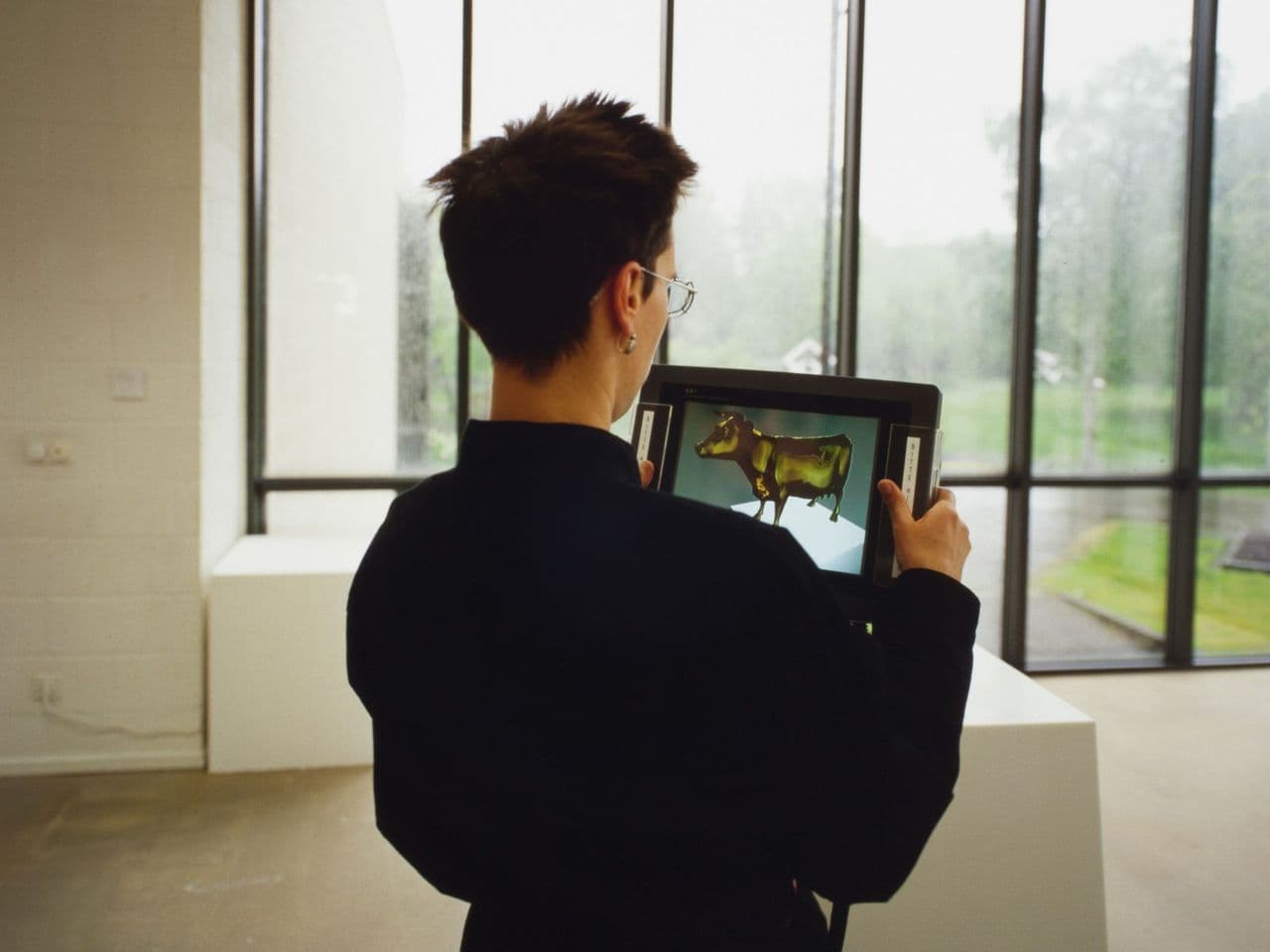
Jeffrey Shaw’s The Golden Calf (1994), a pioneering visionary work of augmented reality that pre-dated AR technology and mobile computing, offers valuable insights and inspirations for the discussion about the virtual and the real in our epoch of the screen-sphere. In the work, viewers hold up a small mobile screen to view and interact with a virtual 3D model of a golden calf in real-time. The virtual object aligns spatially with the viewer’s perspective, appearing to rest atop an empty physical pedestal in the gallery. With its biblical reference and allusion to the modern gallery system, The Golden Calf is both an investigation of the ontological modalities between the real and the virtual, as well as a critique of the fetish of the art object as promoted by the contemporary art market.
The work prefigures the growing complexity and difficulty of the relationship between the real and the virtual as enabled by new forms of screen media and screen culture. At the same time, it demonstrates the potential of the screen as a critical object for serious social critique. Neither mourning the “death of the real” nor blindly championing the omnipresence of the screen as a brave new future, the work opens a practical yet radical pathway for engaging with the new screen in a grounded and forward-looking manner. It shows how the screen can serve as a genuine form of creative and critical probing.
(This excerpt is reprinted with the permission of the author. Part of the text has been revised.)
(Image: Jeffery Shaw’s The Golden Calf, 1994. Image courtesy of the artist.)
Notes
[1] Vivian Sobchack, “Comprehending Screens: A Meditation in Media’s Res,” Rivista di estetica, 55, (2014): 87-101. http://journals.openedition.org/estetica/959
(The views and opinions expressed in this article published are those of the author/s. They do not necessarily represent the views of VMAC.)
Staff Pick
This Moment, That Time: Videotage at 40 – Winnie Fu
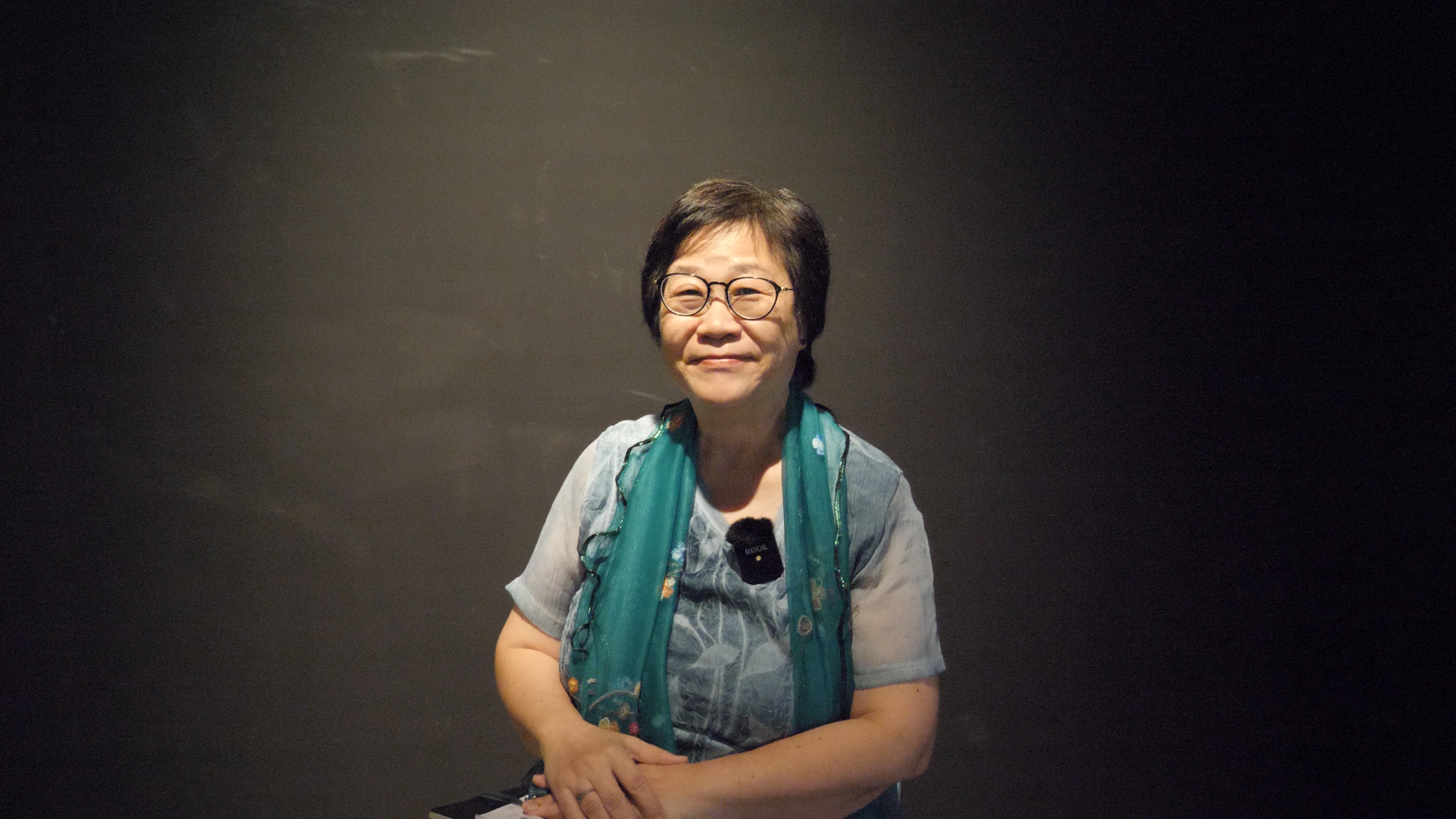
Following Ernest Fung, the next installment of Videotage’s This Moment, That Time oral history series features programme curator Winnie Fu. As the former director of the Microwave International New Media Art Festival, she reflects on her experience curating the early editions of the festival, witnessing its expansion from video to interactive media, bio art and beyond, as well as its evolution from being an initiative of Videotage into an independent organisation.
An active Videotage member in the 1990s, Winnie later became a member of its board of directors. She was also involved in the selection of works and programme curation for the early editions of the Microwave Festival. In the interview, she shares how her interest in image led her to meet artists such as Ellen Pau and Chan Pik Yu, and eventually to travel to and study in Germany on her own. Her exposure to the local art scene there would also inspire her approach to programme curation in Hong Kong.
Outside of Videotage, Winnie worked at the Hong Kong Film Archive for more than 20 years. She describes her work across the two organisations as occupying opposite ends of the spectrum between old and new media. She also unpacks her process of curating programmes at the Film Archive, while reflecting on how curiosity has shaped her experiences and broadened her vision over the years.
The full interview is now available on Videotage’s YouTube channel. Go have a look!

Video Review
Dear Samuel by Rob Crosse, 2019
Selected and reviewed by Liu Ziru (Intern)
Screened in 2019 as part of Videotage’s programme Both Sides Now V: Queer, Rob Crosse’s moving image work Dear Samuel offers a meditation on intergenerational queer desire. Drawing from personal memory and the work of the Hong Kong advocacy group Gay and Grey, the film examines power dynamics between young and aging bodies within a broader social context.
Narratively and sonically, Dear Samuel alternates between calm voice-overs and gently mournful hums. Delivered over a black screen, the voiceover recounts stories of intimate lovemaking and eventual estrangement. In contrast, the humming sequences pair scenes of elderly men playing with birds with breezy yet wistful young voices. Moving from “I can take care of you”, to “They can take care of you”, to “I cannot take care of you”, these hums dissolve into solitary birdsong. This rhythm gives the film a distinctly poetic, prose-like quality.
The work’s visceral impact lies in its refusal to sanitise physical decay. Details like delayed erections, deep wrinkles, and the bedtime removal of dentures and hearing aids strip away the older lover’s blurred sexual image. Far from desexualising the aging body, these moments expose a complex fluidity of desire. Simultaneously, the film upends traditional conventions of care: the younger lover becomes the caregiver, even as underlying power imbalances persist, symbolised by the younger lover kneeling during intimacy. The overall account of their relationship remains open to interpretation; in my reading, their clandestine lovemaking in a nursing home collapses as the older lover refuses to take responsibility for disclosing their bond. This subverts the expectation that age confers maturity or accountability, casting a tragic veil over the story.
By focusing on aging gay men, Dear Samuel challenges traditional norms by exposing emotional fragility across generations. As the final notes dissolve into ambient birdsong, Crosse leaves the viewer suspended in the quiet weight of unfulfilled promises, illustrating how the quietest moments of intimacy often carry the heaviest social burdens.
About VMAC Newsletter
VMAC, Videotage’s collection of video and media arts, is a witness to the development of video and media culture in Hong Kong over the past four decades. Featuring artists from varied backgrounds, VMAC covers diverse genres including shorts, video essays, experimental films and animations. VMAC Newsletter, published on a bi-monthly basis, provides an up-to-date conversation on media arts and their preservation while highlighting the collection and its contextual materials.