

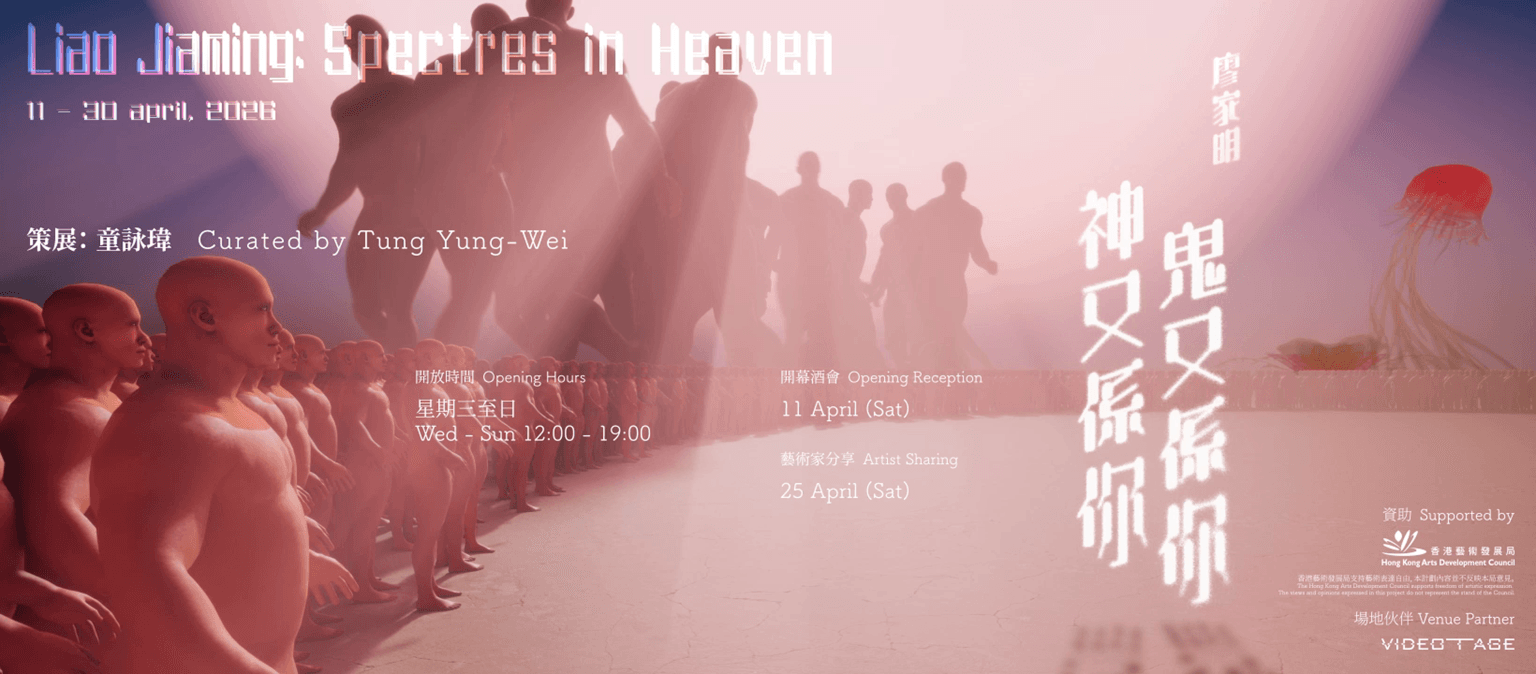


Liao Jiaming: Spectres in Heaven廖家明:神又係你,鬼又係你
“Spectres in Heaven” brings together Liao Jiaming’s recent works across a range of artistic forms and methodologies, engaging themes such as artificial intelligence, queer culture, bodily discipline, and the histories of Hong Kong. The artist turns toward unresolved fragments of the past while confronting indeterminate technological futures. Within this temporal disjunction, the works rearticulate bodily imaginaries that have been lost or remain unrealized.
The exhibition foregrounds a central concern: the irreducible tension between collectivity and individuality. Across the works, the body emerges as a site of production and regulation, where dynamics of control and empowerment unfold in an ambivalent relation. Traced through the artist’s lived trajectories and contradictions, these tensions coalesce into an entangled yet misaligned constellation—one that poses questions rather than offering resolution.
At the center of the exhibition is the interactive game installation Be a Good Man (2026), which can be understood as a virtual microcosm of the exhibition as a whole. Continuing his recurring use of muscular avatars, the artist constructs a highly corporeal otherworld. Drawing visual references from Buddhist mandalas and Hieronymus Bosch’s The Garden of Earthly Delights, this world remains governed by the preset logics of 3D modeling and game engines. As players navigate this environment, they activate portals leading into five chambers, where bodily experiences unfold across divergent temporalities and registers, linking state governance, personal memory, and algorithmic circulation.
The first chamber opens with anonymous archival footage of a Tiananmen military parade, evoking the politicized mobilization of bodies in the early years of the People’s Republic of China. The second shifts to an intimate register, recalling the artist’s memories of school radio calisthenics. The third restages the commodified body as it proliferates through Douyin fitness livestreams. The fourth echoes another work in the exhibition, in which the artist repeatedly practices “finding balance” while drifting within an excess of circulating information. The fifth extends his dating-app series, guiding players toward an idealized body newly generated through artificial intelligence.
Though numbered, these chambers resist any fixed narrative sequence. Players drift within an endless loop of bodily transformation, layered in overlapping strata. Collectivity here appears as a recursive structure—one that encloses even as it opens spaces of refuge and imaginative concealment. Conversely, the promise of freedom and self-realization associated with individualism does not offer a clear path toward renewal, but instead operates as a seductive veneer of desire. The artist’s sustained engagement with queer embodiment reflects on the frictions encountered in his own transition from collective formation into a subsequent stage of life—tensions that find further articulation in IYKYK (2026).
Originally conceived as a live performance, IYKYK stages a simulation of e-commerce and influencer livestreaming, with the artist in his signature prosthetic muscle suit, to engage the technological and capitalist forces that discipline and reconfigure the body. When transposed into the exhibition space, this platform-based mode of spectatorship shifts into embodied participation. During the performance, the audience actively reshaped the artist’s “ideal form,” inscribing their gestures onto the silicone costume now on display. The title, drawn from internet slang, signals forms of meaning accessible only within specific communities. As the boundaries between consumption, desirous gaze, and performative participation collapse, artist and audience alike are implicated as co-creators in the ongoing production of contemporary corporeality.
At a moment when corporeality is no longer fully governed by individual or collective will, “finding balance” emerges as a posture the artist both adopts and interrogates—a way of situating the body in relation to the world and its demands. The three-channel video How to Find Balance on Water (2025), inspired by Hong Kong’s Tanka boat-dweller culture, stages this inquiry by inviting performers to rehearse balance on water at former harbor sites. Meanwhile, contemporary land-dwelling residents of Hong Kong learn and perform Tang Tong Songs—traditionally sung by Tanka communities at weddings and funerals.
The sea and the harbor once formed an intimate part of everyday life in Hong Kong. Here, the artist overlays a disappearing past onto the visible present, evoking an imagined sense of belonging through the interweaving of bodily gestures and sung voices. This sense of belonging is “imagined,” as cultural memory becomes increasingly inaccessible amid urban development. It also points to contemporary migrants in the background of the video—including the artist himself—whose relationship to Hong Kong is marked by simultaneous inclusion and exclusion. Moving from the grounded condition of arrival into a floating register of fiction, the work unsettles fixed identities and the bodily forms that sustain them, inviting viewers to negotiate their own sense of balance amid states of weightlessness and instability.
At the threshold of the exhibition—both entrance and exit—two 3D holographic fans are suspended overhead. The video installation Unsatisfied Eroticism (2022–2026) appears, from a distance, as an indistinct mass of flesh, yet is generated through AI analysis of visual data drawn from two pornographic films. Stripped of explicit human contours, the work exudes a diffuse carnality, pulsating and expanding as if animated by its own internal rhythm.
Building on these dynamics, the exhibition unfolds a cyclical movement between desire, technology, and history: from unnameable images and shell-like surfaces of muscular flesh, through indistinct avatars in virtual space, to bodies that become increasingly concrete and historically referential. Yet “history” here does not emerge as a stable or fully present form. Rather, drawing on the procedural logic of machine learning, it is generated through iterative processes of rehearsal and calibration enacted by performers. This gives rise to a mimetic form of historicity—one that reveals, in its failure to faithfully reproduce the past, the deviations and fractures inherent in its embodiment. Even as the body takes shape, it is continually broken down and reconfigured, undergoing transformation between de-individuation and re-materialization.
The Chinese title of the exhibition, drawn from a Cantonese idiom meaning “you are both the god and the ghost,” carries connotations of capriciousness and deception. Here, however, it is recast as a condition of shifting positionality and strategic ambiguity. Glowing forms scatter across the exhibition space. Bodies and avatars drift among them. As if breathing, spectres extend through this heaven into the fissures of time, continually summoning irreducible forms of subjectivity and shared perception. The artist extends an invitation: to enter a game in which he is not the sole agent of control.
(Images courtesy of the artist.)
「神又係你,鬼又係你」嘗試整合廖家明近年來透過不同藝術類型與方法,橫跨人工智慧、酷兒文化、身體規訓、香港歷史等主題之共同創作關懷——藝術家站在當下此一交錯節點,往後回看未竟的歷史殘篇,往前望向未明的未來科技,從中探尋並重構那些已然佚失或尚未實現的肉身想像。
在此一框架下,本展浮現出一個更為核心的命題:集體性與個體性之間的多重辯證。前述的各個主題及相應作品,皆指向身體在不同尺度下的生成與規訓,並隱含著控制與賦權的雙面刃。兩者間的拉扯張力,經由藝術家個人的身分衝突與生命軌跡彼此串連,形成持續牽引的錯位關係,進而互為提問,而非解答。
首先,《神又是你,鬼又是你》(2026)這件遊戲互動裝置,可視為本展的虛擬縮影。藝術家沿用其過往作品中常見的肌肉虛擬化身,並參考佛教曼陀羅與波希名畫《人間樂園》的視覺意象,打造出一個高度肉體化、卻受制於3D建模與遊戲引擎既定身體邏輯的異世界。玩家穿梭其中,藉由通道的觸發進入五間小室,逐步連結起國家治理、個人記憶與網路演算等層次與時間向度各異的身體經驗。
小室一以一段不知名的天安門閱兵檔案影像為引,回溯新中國成立之初高度政治化的身體動員;小室二轉以私密的口吻,緬懷藝術家求學期間的廣播體操記憶;小室三則重現抖音運動直播間中病毒式擴散的商品化身體;小室四呼應本展的另一件作品,藝術家現身並反覆練習著「保持平衡」,在過剩的資訊海中載浮載沉;小室五延續其「交友軟體」系列作品,引領玩家在人工智能的生成下,獲得一個理想化的嶄新肉身。
這些小室雖被編號,卻無敘事先後,玩家彷彿巡航於身體改造的永劫回歸之中,層層交疊而不見天日。集體主義在此看似構建出一巨大迴圈,卻也為自在隱身撐出了庇護與想像空間;反之,個人主義所承諾的自我實現與自由選擇,未必是通往新生的出口,亦可能只是資本的糖衣。藝術家對酷兒身體的長期關注,即在反思其從集體養成邁向另一人生階段後所遭遇的種種扞格,並進一步延伸至本展的《永不落空》(2026)。
這件作品原為一場行為藝術演出,藝術家穿上其標誌性的仿生肌肉裝,模擬電商與網紅直播情境,以此回應科技資本對身體的操控。從虛擬平台轉移至實體空間,觀眾受邀參與一場身體改造工程,親手重塑藝術家的「完美形體」,並在本展展出的矽膠演出服上留下斑斑痕跡。該作英文名「IYKYK」(if you know you know)為網絡流行語,用以指稱僅對特定群體具意義的內容。隨著消費行為、慾望凝視與觀演互動的界線愈發模糊,你我,作為共同創作者,都被納入了當代身體形構的生產之中。
在肉身難以完全由個體或集體意志主導之際,「保持平衡」成了藝術家現階段追尋與提問的「姿態」。姿態既關乎身體性,卻也不限於此,更指向自身與世界的關係,承載著介入的責任。受香港水上原居民疍家文化啟發,三頻道錄像《陸上行舟》(2025)邀請表演者於昔日碼頭據點模擬「如何在水上保持平衡」,並由當代香港陸上居民學習、吟唱水上人葬禮和婚禮中的「歌堂歌」。
海與港,曾與香港生活相依共存。藝術家將消逝的過去與眼前的當下相重疊,並從身體姿態與吟唱歌聲的交織中,牽動想像的歸屬感。之所以為「想像」,不僅因歷史與文化記憶隨城市發展進程已難再回返;更隱隱指向影片背景中的當代移民,以及同為移居者的藝術家自身,與香港本土之間既融入又被排除在外的矛盾關係。本作從著陸的既存事實,重新回到浮動的虛構想像,除了旨在鬆動現實社會中穩固的身分認同,以及其所依附的身體容器外,更期待引領觀者在失重動盪中,尋覓自身存在的平衡。
在展場的入口亦是出口處,高掛著兩件三維全息風扇。這件名為《暗湧》(2022-2026)的影像裝置,遠觀如一團難以辨識的肉塊,實則由人工智能分析兩部色情影片的圖像特徵所生成。褪去了具體而露骨的人體輪廓,卻更瀰漫著橫流的肉慾,彷彿有著自身生命節奏一般,持續張合。
由此出發,本展試圖開展慾望、技術與歷史之間的往返循環:從無以名狀的圖像與空殼般的肌肉表皮,經由虛擬空間中面目模糊的化身,逐步推移至具象且帶有歷史指涉的肉身。然而,此處的「歷史」並非以穩定實存的形式現身,而是借鏡「機器學習」的運算與指令邏輯,在表演者的反覆學習與校準之中,生成一種歷史性的擬態;其無法精準再現,恰顯現附體的偏差與裂隙——亦即,在肉身看似成形之際,仍不斷打掉重練,並於去個體化與再物質化之間持續變形與重寫。
「神又係你,鬼又係你」原帶有反覆無常的欺騙意味,在此轉化為一種逃脫認同陷阱、暫時安全降落的曖昧狀態,亦是可持續前進或後退的策略位置。在一個看似穩固、實為幽靈籠罩的天堂中,四散的發光體,遊蕩的肉身及化身,如呼吸般向時間的縫隙延展,持續召喚不可化約的主體生成與集體感知。藝術家藉此向觀眾發出邀請:我想帶你進入一場遊戲,但我不是唯一的話事人。
(圖片由藝術家提供。)
event details /
11.4.2026 – 30.4.2026
12:00 – 19:00 (Wed to Sun 三至日)
Opening Reception | 開幕酒會
16:00 | 11.4.2026 (Sat 六)
Artist Sharing | 藝術家分享
16:00 | 25.4.2026 (Sat 六)
Curated by | 策展:Tung Yung-Wei 童詠瑋
Visual Design | 視覺設計:Zhang Riwen 張日雯
Venue Partner | 場地伙伴:Videotage 錄映太奇
Supported by | 資助: Hong Kong Arts Development Council 香港藝術發展局*
* The Hong Kong Arts Development Council supports freedom of artistic expression. The views and opinions expressed in this project do not represent the stand of the Council. 香港藝術發展局支持藝術表達自由,本計劃內容並不反映本局意見。